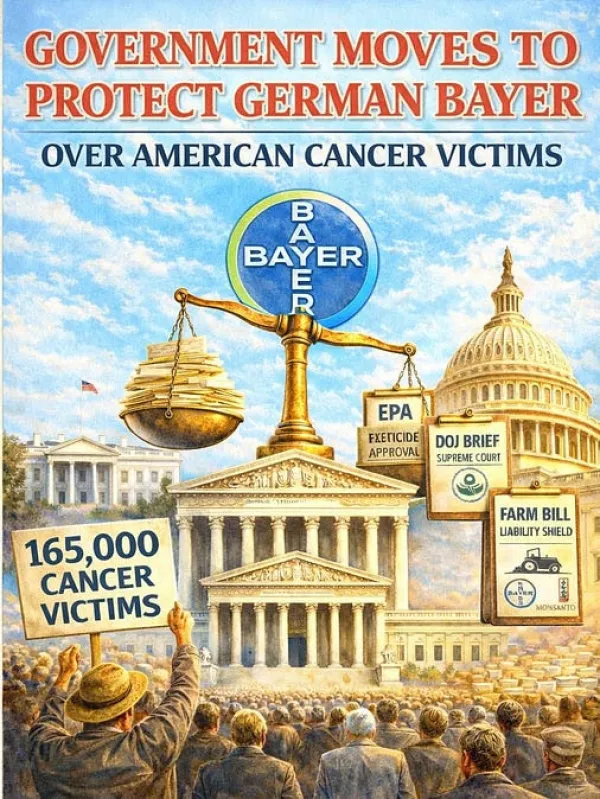
Executive Order Secures Glyphosate Supply, EPA Regulatory Decisions Shape the Legal Defense, DOJ Supports Bayer, the Supreme Court Takes the Case, & House Farm Bill Advances Chemical Liability Shield
Healthy soil, water, and ecosystems are the foundation of human life. The health of creation gives rise to the health of life.
Powerful outside interests are using America’s treasury and public policy to advance profit-driven agendas while the health, land, and future of the American people bear the cost.
The same public purse that finances war abroad is now underwriting policies that poison the land at home.
Political energy that should be confronting this system is instead being redirected into advertising, messaging, and branding, while the real decisions are made through law, regulation, and votes.
While the long planned objectives of a foreign country drew America’s Department of War, the Department of State and the U.S. taxpayer’s purse into an expanding conflict across the Middle East, a foreign corporation, Bayer/Monsanto suddenly blasted onto the policy scene.
In the span of three weeks, the Executive Branch, the Judicial Branch, and the Legislative Branch each took major actions to shield the German corporation, Bayer/Monsanto, from liability as it stands at the center of one of the largest mass injury litigations in American history.
First, President Donald Trump issued an executive order invoking the Defense Production Act to secure the domestic supply of glyphosate-based herbicides and elemental phosphorus, a key industrial input used in the manufacture of agrochemicals and certain weapons systems. Bayer is currently the only domestic producer of elemental phosphorus in the United States.
Second, the Department of Justice filed an amicus brief in the United States Supreme Court supporting Bayer in Monsanto Company v. Durnell, a case addressing whether federal pesticide law preempts state law, placing at risk claims brought by citizens harmed by glyphosate-based herbicides.
Bayer traces its corporate lineage to IG Farben, the German chemical conglomerate that built facilities at Auschwitz and conducted pharmaceutical experiments on concentration camp prisoners. After the Nuremberg trials, IG Farben was dismantled and Bayer emerged as one of the companies created from its breakup. In 2018 Bayer acquired Monsanto, producer of the glyphosate herbicide Roundup.
In June 2025, the U.S. Supreme Court asked the Solicitor General to provide the federal government’s view on whether it should hear Monsanto Company v. Durnell. The Justice Department responded by supporting Bayer’s argument that federal pesticide law should preempt state law claims that companies failed to warn citizens about the risks of their products.
In January 2026 the Supreme Court agreed to hear the case. The decision now before the Court could determine whether tens of thousands of cancer victims’ claims against Bayer/Monsanto survive or disappear.
The Supreme Court receives roughly 7,000 to 8,000 petitions each year and typically agrees to hear fewer than one percent of the cases. Four Supreme Court Justices must agree to grant review and place a case on the national docket.
The Roundup litigation had already moved through a lengthy legal process. Juries examined evidence. Appellate courts reviewed the verdicts. Injured citizens were exercising a long recognized right to seek redress through state tort law.
Yet, four Justices chose for the nation’s highest court to take up the question at the very moment when tens of thousands of claims against Bayer remain pending.
If the Court ultimately adopts Bayer’s argument, the ruling could eliminate thousands of existing Roundup cancer lawsuits and close the courthouse doors to hundreds of thousands of potential future claims. Glyphosate is the most widely used herbicide in the United States, meaning the legal precedent would extend far beyond the cases already filed and would shape the rights of Americans exposed to the chemical glyphosate, as well as other toxic chemicals, for decades to come.
Citizens possess the right to bring claims when they believe a company’s product caused them harm. That right is the foundation of American tort law. Juries examine evidence, determine liability, and hold companies accountable when their products cause injury.
Bayer’s legal strategy seeks to replace that system with federal preemption. If the Environmental Protection Agency approved the label, the company argues, injured citizens should lose the right to sue for failure to warn, even when juries find evidence of harm. If that theory prevails, the courthouse doors close not because a jury rejected the evidence, but because federal regulatory approval becomes a legal shield against accountability.
The Court’s decision to hear the case could set the stage for a significant narrowing of citizens’ ability to seek redress through state tort law, raising profound questions about due process under the Fourteenth Amendment. In this respect, the stakes echo the Court’s decision in Citizens United v. Federal Election Commission, which dramatically expanded the political spending rights of corporations under the First Amendment and reshaped the balance of power in American elections.
Third, House Farm Bill negotiations advanced language that would strengthen pesticide preemption and shield chemical manufacturers from certain state-based liability claims.
Executive action, judicial review, and legislative protection have now moved in the same direction, impairing the basic rights of people to recover damages for injuries caused by poisonous chemicals.
Glyphosate sits at the center of one of the largest mass injury litigations in American history. More than 165,000 Americans have filed lawsuits alleging that exposure to Roundup and other glyphosate based herbicides caused their Non-Hodgkin lymphoma.
Bayer agreed in 2020 to a settlement package worth up to $10.9 billion to resolve a large share of existing claims. Tens of thousands of cases remain pending as new litigation continues, leaving Bayer’s potential exposure in the hundreds of billions of dollars.
Previously, injured citizens brought claims. Evidence was examined. Juries reached conclusions. Now, instead of allowing Americans to continue seeking legal recourse for grave harms, the federal government is moving to shield Bayer from liability. The Department of Justice argues that if the Environmental Protection Agency approved the label, injured citizens should lose the right to sue for failure to warn.
The Farm Bill language now under consideration would harden that shield. Rep. Chellie Pingree described the provision plainly, warning that it would protect chemical manufacturers such as Bayer from lawsuits and preempt state and local warning label laws or usage regulations.
The provision would also undercut local authority to act when federal regulators delay or defer to industry pressure. Seven states currently do not preempt local governments from regulating pesticide use. Pingree’s office warned that in Maine alone more than thirty state and local pesticide protections could be undermined by the proposed language.
This matters because states carry constitutional responsibility for protecting the health and welfare of their citizens.
State tort law, consumer protection law, and public health authority form the backbone of that responsibility. When federal law blocks states and municipalities from regulating pesticide exposure or pursuing accountability for harm, local governments lose the tools they rely on to protect their communities.
The American farmer carries the risk while the chemical manufacturer receives the shield.
The consequences extend far beyond agriculture. Physicians, nurses, oncologists, hospitals, public health officials, and health insurers should be at the forefront of this fight. Glyphosate induced Non-Hodgkin lymphoma imposes enormous costs on patients, families, medical systems, and insurers.
When chemical companies are shielded from liability, those costs do not disappear. They shift to hospitals, insurance systems, families, and taxpayers. This is a public health crisis moving through the American food system and across the landscape of the American heartland.
The system that produced this crisis has deep historical roots.
Modern chemical agriculture arose in the context of warfare. The twentieth century chemical industry developed many of its core technologies during periods of global conflict, and after World War II chemical manufacturing capacity and scientific expertise were redirected toward agriculture. The language followed the chemistry.
We declared war on weeds, war on insects, and war on fungi. Fields became battlegrounds. Industrial agriculture relies on chemicals designed to kill. Herbicides kill plants. Insecticides kill insects. Fungicides kill fungi. This is Ecocide.
These compounds eliminate living organisms in the interests of industrial production. Some targets are labeled pests. Many others are casualties of unregulated industrial production. Pollinators, soil organisms, birds, aquatic life, and beneficial insects disappear from landscapes saturated with chemical inputs.
Human beings live inside those same landscapes. Farmworkers, rural communities, and consumers become collateral damage in a system built to deploy lethal chemistry across millions of acres.
Ecocide becomes a pathway to human suffering and disease.
The mentality that accepts ecological destruction in pursuit of control resembles the mentality that accepts civilian casualties as an unavoidable cost of war. Life treated as expendable in one arena rarely remains protected in another.
The American heartland must challenge a permanent war against the living systems that sustain it, and us!
At the same time, the Environmental Protection Agency (EPA) is reshaping pesticide regulation in ways that benefit the chemical industry. The agency has accelerated pesticide approvals, delayed safety reporting requirements for toxic chemicals, and allowed chemicals to remain on the market while safety reviews remain incomplete. Those regulatory decisions now form the scientific basis the Justice Department is asking the Supreme Court to treat as final authority on pesticide safety.
At the very moment those regulatory decisions are being used in court to protect chemical manufacturers, the scientific infrastructure inside the EPA is being weakened. Last year EPA officials began dismantling the agency’s research office that provided much of the scientific foundation for chemical risk assessments. Career scientists warned that removing this office will weaken independent analysis and increase the risk of political interference in decisions about chemical safety.
Congress is moving in the same direction. Separate legislation introduced by Republican lawmakers would weaken the nation’s toxic chemical laws by limiting the scientific evidence regulators can use to determine health risks and by giving industry a larger role in the chemical assessment process under the Toxic Substances Control Act, the federal law that governs chemical safety in the United States.
While these proposals are not part of the Farm Bill itself, they move the regulatory system in the same direction. The scientific guardrails that once helped protect public health are being weakened, and industry influence over chemical safety decisions is expanding.
In short, government policy and law are being rewritten to shield chemical companies while the public bears the risk.
The revolving door between the chemical industry and federal regulators is visible. Four chemical industry lobbyists now sit in the top four posts at the EPA office that regulates chemicals and pesticides. One example is Kyle Kunkler, now a Deputy Assistant Administrator in the EPA’s Office of Chemical Safety and Pollution Prevention, previously worked as a pesticide lobbyist for the American Soybean Association.
Inside the White House, Chief of Staff Susie Wiles previously worked at Mercury Public Affairs, a lobbying firm that later registered to represent Bayer, according to U.S. Right to Know’s reporting on Bayer’s influence network in Trump’s Washington.
Investigations by U.S. Right to Know document the scale of Bayer’s influence campaign in Washington. Their reporting, Tracing Bayer’s Ties to Power in Trump’s Washington, details the company’s network of lobbyists and political influence across Congress and federal agencies.
According to U.S. Right to Know, Bayer spent $9.19 million lobbying Washington in 2025, employing dozens of lobbyists across more than a dozen firms. The Justice Department brief supporting Bayer was signed by Deputy Solicitor General Sarah M. Harris and Assistant to the Solicitor General Aaron Z. Roper, both of whom previously worked at Williams & Connolly, the law firm that defended Monsanto in major pesticide litigation.
Corporate power now operates across the three arenas that shape American law. Legislatures write the law. Regulators determine the science that informs it. Courts decide how that law is interpreted. Bayer and its allies operate in all three arenas.
During the House Agriculture Committee markup of the Farm Bill, Rep. Chellie Pingree (D-ME) introduced an amendment to strip the pesticide liability shield from the bill. Every Republican on the committee voted to keep the liability shield. Every Democrat but one voted to remove it.
Chairman Glenn “GT” Thompson defended his bill as bipartisan and dismissed criticism that it served industry interests as a mischaracterization of the facts. The committee ultimately approved the bill 34 to 17, with seven Democrats joining Republicans.
Several members of Congress from both parties have attempted to push back against chemical industry influence.
Rep. Thomas Massie (R-KY) and Rep. Chellie Pingree (D-ME) introduced the bipartisan No Immunity for Glyphosate Act, which would prevent pesticide manufacturers from receiving federal liability protections tied to glyphosate.
Rep. Jim McGovern (D-MA) has warned that chemical agriculture policy now contradicts the public health goals many lawmakers claim to support, and Rep. Anna Paulina Luna (R-FL) has introduced legislation to ban the herbicide diquat.
Resistance exists inside Congress. The pressure of industry lobbying remains immense. This is all the more reason why a unified movement must galvanize around issues and not political parties. Food touches on all issues and all aspects of our lives.
Robert F. Kennedy Jr. helped to catalyze a movement demanding a transition away from chemical intensive agriculture and toward regenerative organic farming. I helped organize that effort and hosted the campaign’s national agriculture roundtable that brought together farmers, scientists, and food system leaders and drew more than 36,000 participants. That movement carried a clear mandate, to end chemical dependency in agriculture, restore soil health, and protect farmers and public health, and by doing that, create on farm and economic resilience.
Dr. Bob Quinn, PhD in Plant Biochemistry, regenerative organic pioneer and Montana farmer, is a longtime friend and mentor. He built the internationally recognized Kamut ancient grain brand and has spent decades demonstrating that regenerative organic agriculture can succeed at scale.
During Senator Roger Marshall’s MAHA soil health roundtable, and in policy recommendations delivered to Secretary of Agriculture Brooke Rollins and Secretary of Health and Human Services Robert F. Kennedy Jr., Quinn framed the issue with striking clarity.
Dr. Quinn has shown through both science and practice that regenerative organic transition can restore farm profitability while building viable market pipelines for farmers. His own family farm was once operating in the red, burdened by the rising costs of chemical inputs and seed. Out of economic necessity he transitioned to organic production. That decision not only saved the farm, it helped establish the pathway he now shares with farmers across the country who seek to restore both economic independence and soil health.
Dr. Quinn describes the shift away from toxic chemical agriculture toward regenerative organic systems as Pro Life agriculture. Life with a capital “L”, from the genome and the unborn child to the living soil, the farmer, and the entire ecosystem of creation.
This systems perspective recognizes a simple truth: Everything is connected. The health of one part of creation determines the health of the whole.
The phrase captures the moral clarity this moment demands. The foundations of life itself are being eroded at accelerating rates.
The chemicals at the center of this debate are designed to kill. A policy that shields companies producing lethal chemicals from accountability cannot honestly claim to defend life. The American heartland needs Pro Life agriculture.
Millions of Americans who supported this administration identify strongly as pro life. That conviction carries profound moral weight, and it demands consistency. Yet many of the same elected officials who campaign on protecting life are advancing chemical liability shields and deregulation that protect corporations while exposing farmers, families, and communities to harm.
Citizens must now ask their legislators and their government a simple question: Does this policy truly protect life? Does it protect the soil, the farmer, the farmworker, the child, the patient, and the community? Is this policy truly Pro Life, with a capital L?
American agriculture now operates inside a chemical dependency system engineered through decades of policy, subsidies, and corporate influence. The country should be helping agriculture enter a recovery program from chemical dependency.
Farmers did not create this system alone. Recovery requires new markets, new infrastructure, crop insurance reform, transition support, and policies that reward soil health rather than chemical throughput.
The power of this moment does not sit inside Washington alone. It sits with the farmers, families, physicians, and citizens who built this movement.
The coming midterm elections will determine whether chemical agriculture tightens its grip on American law or whether citizens reclaim the mandate they created. Policy does not move in a vacuum. It moves in response to political pressure, public scrutiny, and the willingness of citizens to hold their representatives accountable.
This moment should serve as a clear lesson in how power actually moves in Washington. Advertising may shape public narratives, but law shapes the systems that govern our food, our farms, and our health.
The alignment that occurred across the Executive Branch, the Judicial Branch, and the House of Representatives shows how quickly policy can move when powerful interests are focused on shaping legislation, regulation, and potential court outcomes. If Americans want to change the direction of the food and farming system, their attention must now turn to the place where the law is still being written.
That place is the United States Senate.
__
(A guide to Senate Farm Bill Action to follow later this week)